
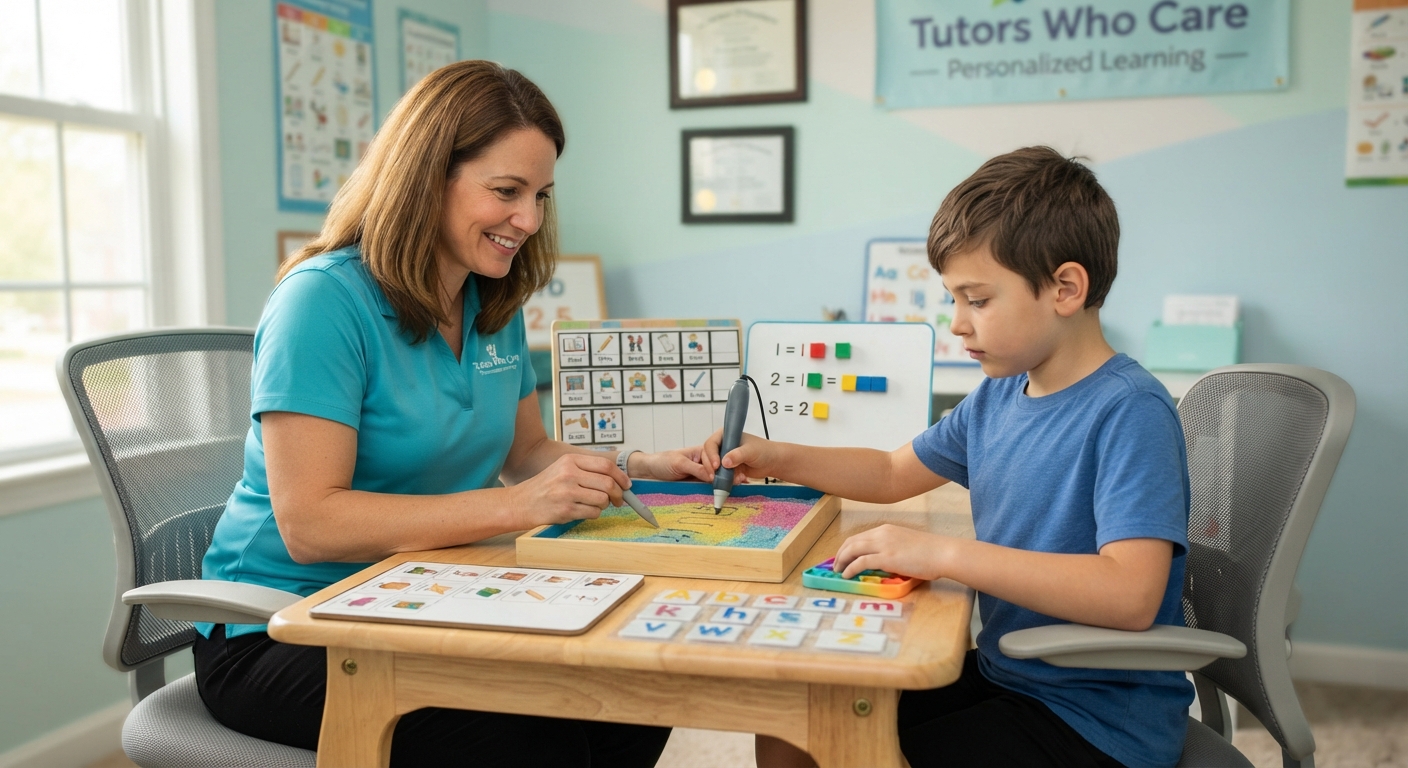
Every child learns differently. Some children understand new concepts quickly through reading, while others learn best through hands-on activities, visual demonstrations, repetition, or individualized instruction. For children with disabilities, learning differences, or additional educational needs, the right support can make a meaningful difference in their academic experience and confidence.
If your child is struggling with reading, writing, mathematics, attention, communication, organization, or homework, you may be wondering whether a special needs tutor could help. You may also have questions about finding a qualified tutor, working with your child’s school, understanding an Individualized Education Program (IEP), and creating a positive learning environment at home.
This guide from Tutors Who Care explains what parents should know about special needs tutoring, how to evaluate tutoring options, what questions to ask before hiring a tutor, and how to support your child’s progress over time.
The goal is not to make every child learn in the same way. It is to help each child access learning in a way that recognizes their individual strengths, needs, interests, and goals.
Special needs tutoring is individualized academic support designed around a student’s learning needs, abilities, educational goals, and preferred ways of learning.
Unlike a general tutoring session that may focus primarily on completing homework or reviewing classroom lessons, specialized tutoring may require adjustments to instructional methods, lesson length, materials, communication, pacing, and the learning environment.
A tutor may help a student strengthen foundational academic skills, practice concepts introduced at school, develop more effective study habits, or learn strategies for approaching challenging assignments.
Depending on the student’s needs and the tutor’s qualifications, support may include:
Special needs tutoring is not a one-size-fits-all service. A student who needs help with reading may benefit from explicit, systematic instruction, while another student may need visual schedules, shorter learning activities, or support with organizing assignments.
The best starting point is understanding what the child finds difficult, what they already do well, and what kind of support will help them participate more confidently in learning.
Special needs tutoring may be helpful for children and teens with a wide range of learning profiles. A diagnosis does not automatically determine which tutoring approach will be appropriate. The student’s individual needs, current skills, preferences, and goals should guide the decision.
Autistic students have diverse strengths and support needs. Some may benefit from predictable lesson structures, clear explanations, visual supports, explicit instructions, or additional processing time.
A tutor may help an autistic student practice reading, writing, mathematics, academic communication, and organization while respecting the student’s communication preferences and sensory needs.
Helpful considerations can include:
The tutor should avoid assuming that all autistic students learn in the same way. Strategies should be adapted to the individual rather than based on stereotypes.
Students with attention-deficit/hyperactivity disorder (ADHD) may experience difficulties with attention regulation, planning, time management, organization, or completing multistep assignments.
A special needs tutor can help make academic work more manageable by dividing larger tasks into smaller steps, identifying priorities, and creating predictable routines.
Potential strategies include:
The purpose is not to expect a student to concentrate continuously. It is to help the student learn strategies that make it easier to begin, manage, and complete academic tasks.
Dyslexia is a learning difference that primarily affects word reading and spelling. Students with dyslexia may need additional instruction in phonological awareness, sound-letter relationships, decoding, spelling, reading fluency, and other foundational literacy skills.
Parents should ask whether a potential tutor has specific training and experience in evidence-based reading instruction.
Depending on the student’s assessment and instructional needs, support may include:
A general homework tutor may not have the specialized knowledge required to address persistent reading difficulties. Ask about the tutor’s training, instructional approach, and experience with students who have similar needs.
Dyscalculia is associated with persistent difficulties involving mathematical understanding and skills. Other students may struggle with mathematics for different reasons, including gaps in foundational knowledge, language demands, anxiety, or difficulty remembering multistep procedures.
Tutoring can help identify specific areas of difficulty and provide structured practice.
Instruction may involve:
The tutor should monitor understanding rather than simply assigning more problems. Repeated practice is most useful when it addresses the student’s actual learning needs.
Some students have specific learning disabilities that affect reading, written expression, mathematics, or other aspects of academic learning.
A tutor may reinforce classroom concepts, help develop foundational skills, or provide alternative ways to practice and demonstrate understanding.
Before choosing a tutor, identify the particular academic skills that need attention. A broad label such as “learning disability” does not explain exactly what a student needs to learn or which instructional methods will be most helpful.
Some children need additional support understanding spoken directions, learning vocabulary, expressing ideas, or interpreting language-heavy assignments.
A tutor may help with academic vocabulary, reading comprehension, written responses, and understanding the language used in mathematics and other subjects.
Parents should distinguish academic tutoring from speech-language therapy. A tutor can support academic learning within their qualifications, but a licensed speech-language pathologist may be needed for communication assessment or treatment.
Some students benefit from additional time, repeated instruction, concrete examples, visual supports, and carefully sequenced learning activities.
Tutoring goals should be individualized and appropriate to the student’s current skills and educational priorities.
Depending on the student, lessons may focus on foundational literacy, mathematics, functional academic skills, communication within academic activities, or increasing independence with schoolwork.
Progress should be measured against meaningful individual goals rather than solely by comparison with other students.
Executive functioning involves skills used to plan, organize, remember instructions, manage time, and monitor progress toward a goal.
A student may understand a subject but struggle to start assignments, keep track of materials, or complete work by a deadline.
Tutoring may include direct practice with:
The aim is to teach repeatable strategies that students can gradually use with less assistance.
Children develop at different rates, and one difficult assignment does not necessarily indicate a learning problem. However, persistent difficulties may suggest that additional support is worth exploring.
Consider speaking with your child’s teacher or another appropriate professional if you notice that your child:
These observations do not establish a diagnosis. Learning difficulties can have different causes, and a tutor should not be expected to diagnose a disability.
If you are concerned about your child’s development or learning, speak with the child’s teacher and consider discussing the concerns with a pediatrician or qualified educational professional.
The American Academy of Pediatrics offers an overview of learning disabilities and guidance for families at:
https://www.healthychildren.org/English/health-issues/conditions/learning-disabilities/
When tutoring is appropriately matched to a student’s needs, it can provide additional opportunities to practice skills, receive feedback, and develop more effective learning strategies.
One-to-one instruction gives the tutor more opportunity to observe how a student approaches a task and identify where confusion begins.
The tutor can adjust the pace, examples, explanations, and practice activities according to the student’s responses.
A student may need more practice with a particular skill than a classroom schedule allows. Tutoring can provide additional opportunities to work on that skill without rushing through the lesson.
Practice should remain purposeful and appropriately challenging rather than repetitive for its own sake.
Repeated experiences of understanding a concept or completing a difficult task can help students recognize their own capabilities.
Confidence is best supported through realistic goals, specific feedback, and recognition of effort and progress—not through pressure to perform perfectly.
Effective tutoring should help students develop strategies they can use beyond the tutoring session.
For example, a tutor might demonstrate how to break down a writing assignment, then gradually encourage the student to use the same process independently.
Some students need help developing predictable routines for homework, revision, and assignment completion.
A tutor can model planning strategies and help the student practice them until they become easier to use.
With appropriate consent and attention to student privacy, tutors and parents can share information about learning goals, successful strategies, and areas requiring further practice.
When appropriate, communication with the school can help keep tutoring aligned with classroom expectations and the student’s educational plan.
Tutoring is not a guaranteed solution, and results vary. Progress depends on the student’s needs, instructional quality, consistency, and the suitability of the approach.
Both in-home and online tutoring can be useful. The right choice depends on the student’s needs, preferences, available resources, and the skills being taught.
In-home tutoring allows instruction to take place in a familiar environment.
Potential advantages include:
Parents should still consider the student’s sensory preferences, available space, safety, and ability to focus at home.
Online tutoring can provide access to tutors who are not located nearby and may reduce travel time.
Potential advantages include:
Online tutoring is not ideal for every student or every learning goal. Consider whether the student can comfortably use the technology, engage with the format, and receive the level of support needed.
Ask yourself:
The best format is the one that allows the student to participate meaningfully and make progress toward appropriate learning goals.
Choosing a tutor is an important decision. A tutor should have relevant academic knowledge, appropriate experience, effective teaching skills, and a respectful approach to working with children.
Use the following criteria when comparing candidates.
Ask about the tutor’s educational background, teaching experience, professional training, and experience working with students whose learning needs resemble your child’s.
For specialized reading instruction, for example, ask about training in structured literacy. For mathematics, ask how the tutor identifies gaps in foundational understanding.
A general tutoring background may be suitable for some goals, while others require more specialized expertise.
A good tutor should be willing to learn about the student as an individual.
They should ask about strengths, interests, existing skills, challenges, effective supports, and the family’s priorities.
Be cautious of anyone who assumes that all students with the same diagnosis need the same teaching method.
Ask the tutor to explain how they approach a challenging concept.
Look for an approach that includes explicit explanations, guided practice, opportunities for independent work, and checks for understanding.
The tutor should be able to explain why a strategy is appropriate and how they will adjust it if the student is not making progress.
Students should be treated with dignity, regardless of their academic performance or support needs.
Look for someone who listens, provides constructive feedback, and avoids shaming, intimidation, or unrealistic promises.
Your child should feel safe asking questions and making mistakes.
The tutor should be able to explain how learning goals will be established and reviewed.
Useful goals identify a specific skill, describe what progress looks like, and provide a way to measure change.
For example, a reading goal might focus on improving the accuracy of decoding unfamiliar words using a defined set of skills.
The exact goal should be based on the student’s starting point and educational needs.
Ask how often the tutor provides updates, what those updates include, and how concerns will be handled.
Useful updates explain:
Regular communication helps parents understand whether tutoring is meeting its purpose.
Ask about background checks where applicable, professional references, safeguarding procedures, supervision arrangements, and policies for working with minors.
For online tutoring, discuss privacy, recording policies, communication boundaries, and the use of digital platforms.
Requirements vary by location and setting, so parents should verify relevant local requirements.
Before committing to a tutoring arrangement, schedule a conversation to determine whether the tutor is a suitable match.
The answers should help you understand the tutor’s suitability, approach, communication style, and expectations.
Preparation can help a tutor understand the student’s needs and make the first session more productive.
Explain the academic skills your child finds difficult, what has helped previously, and any approaches that have not worked well.
Where appropriate, share relevant examples of schoolwork, teacher feedback, assessment results, or educational plans.
You do not need to disclose every detail about your child. Share information that is relevant to tutoring and handle sensitive records carefully.
Rather than trying to address every academic difficulty at once, choose a few initial priorities.
For example:
The tutor can help refine these priorities after observing the student’s current skills.
Tell the tutor what your child enjoys, what motivates them, and what activities help them feel comfortable.
A student’s interests can provide useful starting points for examples and learning activities.
For in-home tutoring, choose a space with suitable lighting, comfortable seating, and the materials needed for the session.
Consider whether the student needs reduced background noise, movement opportunities, visual supports, or other adjustments.
The goal is not to create a perfect classroom at home. It is to make learning accessible and comfortable.
Explain what tutoring is, why it is happening, and what the child can expect.
Avoid presenting tutoring as a punishment or suggesting that the child is failing.
Where appropriate, involve your child in choosing goals and identifying